Market insightUnited Arab Emirates
Why the Dubai property market is planning for a smaller city
Dubai gained about 332,000 residents in a single year. Its own 2040 master plan assumed roughly a quarter of that pace. That gap is the real story.
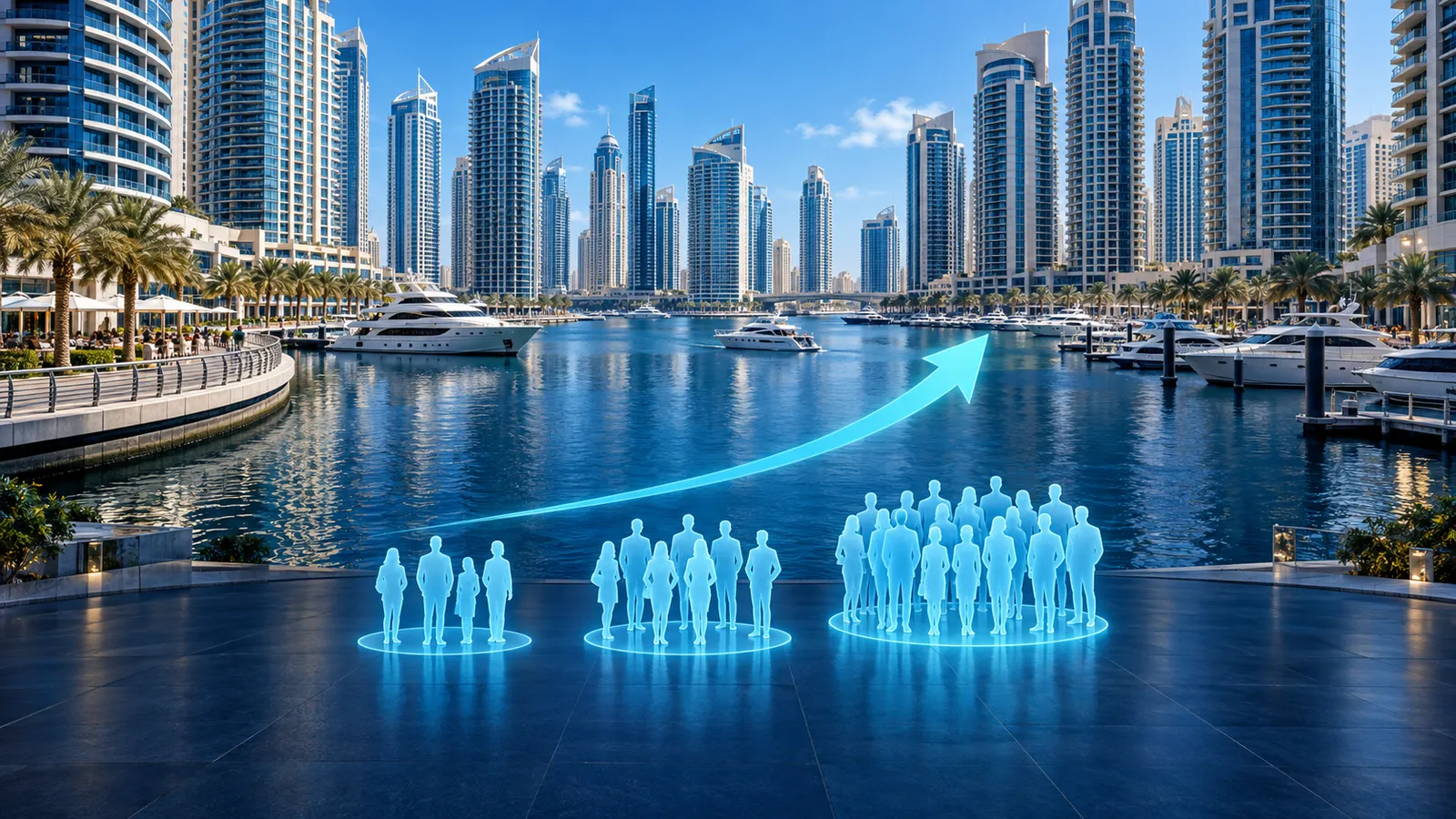
Dubai population growth added a third of a million residents in one year
Dubai added roughly 332,000 residents in 2025, a figure published on 30 July 2026. The most quoted number in the Dubai property market this year has been a fall in transaction volumes, but this one matters more.
Dubai's resident population reached 4.580 million at the end of 2025, up by roughly 332,000 on the end of 2024. That is a growth rate of 7.5 percent, and it is the figure the Dubai Data and Statistics Establishment put its name to. The same release put the population at an average of 6.392 million during peak daytime hours, counting the commuters who arrive each working day but sleep elsewhere.
Three hundred and thirty two thousand people is a mid-sized European city arriving in twelve months. Every one of them needs somewhere to sleep, whether they buy, rent, or share.
Turn that into housing and the scale becomes clearer. Even at three people per household, a year of that growth implies demand for more than a hundred thousand additional homes, spread across every price band from labour accommodation to waterfront. The buy to let end of that demand is a fraction of it, but the fraction is still large. International capital keeps looking at property across the Emirates while the headlines talk about a slowdown.
One caveat belongs here. Population growth is not evenly distributed across segments. A hundred thousand new service workers and a thousand new fund managers create very different housing demand, and the second group is the one that moves prime prices. Any argument that maps total population onto one price band is doing something the data does not support.
The 2040 plan assumed a slower city than this one
Here is where the arithmetic turns interesting. The Dubai 2040 Urban Master Plan was launched in March 2021. Its launch bulletin projects the resident population rising from 3.3 million in 2020 to 5.8 million in 2040.
Dubai was already at 4.580 million at the end of 2025. Getting from there to 5.8 million over the following fifteen years means adding about 81,000 residents a year on average. In 2025 the city added roughly four times that.
This is not a criticism of the plan. A master plan is a spatial instrument, not a forecast anyone is scored against, and planners set conservative population envelopes on purpose. But it does reframe the supply argument. When people say Dubai is building too much, they are measuring construction against a baseline the city passed years early.
Land is the constraint the plan actually enforces
The part of the 2040 plan that binds hardest is not the population line. It is the land.
The plan commits 60 percent of the emirate's total area to nature reserves and rural natural areas. It doubles green and recreational space. It raises land for hotels and tourist activities by 134 percent and takes commercial land to 168 square kilometres. Education and health facilities gain 25 percent more space. The length of public beaches grows by as much as 400 percent.
Read that list again from a buyer's seat. Almost every line either protects land from development or allocates it to something other than housing. Growth is directed into five named urban centres: Deira and Bur Dubai, Downtown and Business Bay, Dubai Marina and JBR, the Expo 2020 centre, and Dubai Silicon Oasis. Where you can build is decided in advance, and the residual is smaller than an open desert map suggests.
That is the mechanism worth understanding. Supply in Dubai is not limited by how much sand exists. It is limited by where the plan permits building and how fast the permitted areas can be delivered.
What the five centres mean in practice
Each centre carries a different housing character, and the plan is explicit about their roles. Deira and Bur Dubai are the historic core. Downtown and Business Bay are the financial and commercial centre. Dubai Marina and JBR are the tourism and coastal belt.
The Expo 2020 centre is the new growth pole in the south. Dubai Silicon Oasis is the knowledge and innovation centre.
For a buyer that list is a shortlist, not a description. A one-bedroom apartment inside Business Bay and a one-bedroom apartment an hour out sit in the same emirate and the same price table. Only one of them is inside a corridor the government has committed to serve. Our UAE buying guide covers the mechanics of a purchase; this is the layer above it, the question of where the purchase should be.
What the delivery record does and does not tell us
The honest answer on completions is that the public record is thin. Dubai Statistics Centre publishes housing unit and completed building series, and the most recent published year on its housing and building pages is 2024. Full-year 2025 completion figures are not yet in the official series.
What circulates instead are consultancy and developer estimates, and they do not agree with each other. Launch announcements are a poor proxy, because a launch is a marketing event and a handover is a building. The gap between the two has been persistently wide in Dubai, and any figure that treats them as interchangeable overstates supply.
So a careful reader should hold two things at once. Announced supply looks large. Delivered supply is smaller, harder to verify, and arrives later than announced. Until the 2025 official series is published, anyone quoting a precise handover count is quoting an estimate.
There is a practical test a buyer can run without any of these figures. Ask a developer how many units it has handed over in the last three years and on what dates, then check those projects against the land registry. A company that delivers on schedule will answer quickly. One that does not will talk about launches. Our guide to buying property in Dubai sets out the other checks that belong in the same conversation.
What an under-called population means for a buyer
If the city is filling faster than its planning baseline, three things follow for anyone weighing Dubai property prices against the noise.
- Rental demand has a floor that transaction volumes do not show. Sales activity reflects investor sentiment and moves with the news cycle. Occupancy reflects how many people live here, and that number went up by 332,000 in a year. The peak daytime average of 6.392 million adds a second layer, because commuters generate demand for offices, retail and short stays even when they sleep in another emirate.
- Location inside the plan matters more than location on a map. A unit inside one of the five named urban centres sits where the emirate has committed its infrastructure. A unit outside them is betting on a later phase.
- Handover dates deserve more scrutiny than headline prices. If delivered supply keeps running behind announced supply, the risk in a long-dated off-plan purchase is timing, not price.
The indicator to watch is the Dubai Statistics Centre housing and building series. When the 2025 full-year completion figures appear there, the supply side of this question can be answered from official data rather than from estimates.
None of this argues that every Dubai purchase works. It argues that the population figure and the land policy are the two most durable inputs, and both are published.
Your next step in Dubai
If you are weighing an entry into the Dubai property market, start with the two numbers in this article rather than the monthly transaction headline. Then narrow to a specific community and a specific handover date. Residency rules can change the arithmetic too, and our Dubai Golden Visa guide sets out the current thresholds. SmartDecision Properties works through that sequence with buyers, from shortlisting inside the 2040 urban centres to checking a developer's delivery record before anything is signed.
Common questions
- Is there an oversupply of housing in Dubai?
- The published evidence does not settle it. Dubai added roughly 332,000 residents in 2025 according to the Dubai Data and Statistics Establishment, while official full-year completion figures for 2025 have not yet appeared in the Dubai Statistics Centre series. Announced launches run well ahead of actual handovers, so comparing launch counts to population growth overstates supply.
- What does the Dubai 2040 Urban Master Plan mean for property buyers?
- It decides where building is allowed. The plan directs growth into five urban centres, commits 60 percent of the emirate's area to nature reserves and rural natural areas, and expands land for tourism, commerce, education and health. For a buyer it means a unit's position relative to those centres is a structural factor, not a marketing line.
- How fast is Dubai's population growing?
- The resident population reached 4.580 million at the end of 2025, up about 332,000 on the year before, a rate of 7.5 percent. During peak daytime hours, when commuters are counted, the average rises to 6.392 million. Both figures come from the Dubai Data and Statistics Establishment release of 30 July 2026.
- Are Dubai property prices rising or falling in 2026?
- This article does not carry a verified 2026 price figure, so it cannot answer that with a number. Coverage during 2026 has focused on transaction volumes rather than values, and volumes and prices are separate questions. Treat any single monthly figure as a snapshot and check the source and date before acting on it.
- Should I buy completed property or off-plan in Dubai?
- It depends on how much timing risk you can carry. Completed stock gives you a rent from day one and no delivery risk. Off-plan usually prices lower and spreads payment, but Dubai's record of launches outrunning handovers means the delivery date deserves as much attention as the price.