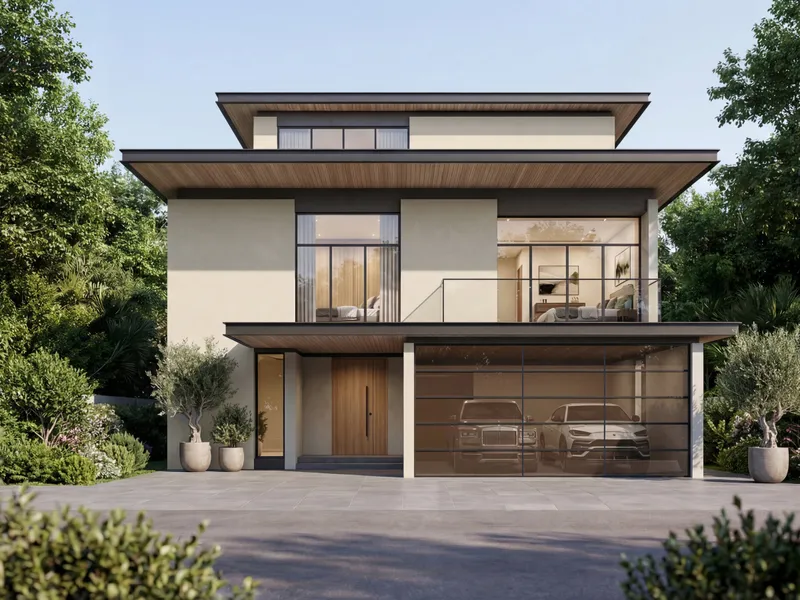
 Golden Visa eligibleUAE-00018
Abu Dhabi: Detached Villas with Private Pools
Abu Dhabi
- 4–6beds
- 5–8baths
- 400–593 m²
Off-plan · 2029
From€2,122,420
3 properties found
Golden Visa eligibleUAE-00018Abu Dhabi
Off-plan · 2029
 Golden Visa eligibleUAE-00017
Abu Dhabi
Off-plan · 2029
 Payment planUAE-00016
Abu Dhabi
Off-plan · 2029
Looking at property for sale in Abu Dhabi is not the same exercise as looking at Dubai, and the difference is legal rather than only financial. The two emirates sit in one country but construct ownership differently, and that changes the document you end up holding.
The stock on this page reflects that difference: less tower apartment, more house with land around it.
Abu Dhabi's new supply runs horizontal where Dubai's runs vertical. Detached villas of four to six bedrooms, homes with their own garden and pool, garden houses laid out with a separate majlis for receiving guests. Plots run past four hundred square metres.
That fixes the buyer profile from the start. For an investor playing short-term lets, a unit like this is too large and too expensive. For a buyer moving a family in, or looking for a long-term tenant, it is a standard of living the same money does not reach in Dubai.
The same development also carries canal-facing apartments, so the entry level is not closed off. But what gives this page its character is the house rather than the flat, which is why a villa for sale Abu Dhabi search tends to end up here.
Foreign ownership in Abu Dhabi is governed by Law No. 19 of 2005, and it sets out four distinct routes. The difference between them is not a technicality; it is the right itself.
Ownership. The deed is issued for 99 years and gives you disposal of the apartment or villa. The point to watch: this route covers the dwelling, not the land beneath it.
Musataha. A 50-year term, renewable for similar periods, carrying rights of use, construction and alteration.
Usufruct. A term of up to 99 years, but limited to use; it does not carry the right to alter the property.
Long-term lease. Established with an initial period of at least 25 years.
The investment areas open to foreign nationals are named one by one in the legislation: Yas Island, Saadiyat, Reem, Mariya, Lulu, Al Raha Beach, Sayh Al Sedairah, Al Reef and Masdar City. A 2019 amendment widened the position for non-UAE nationals in those areas, giving holders of usufruct and musataha of more than ten years broader powers of disposal and mortgage.
So the question to ask is not whether a unit is freehold. The right question is which of the four routes it comes through, for how many years, and what the deed actually says. Ask for that in writing before contract.
The emirate's property transactions run through the Abu Dhabi Real Estate Centre, which under Law No. 3 of 2005 maintains the property register and records transactions relating to property. You are not looking at Dubai's authority here.
There is also a separate initial register covering off-plan development projects, where buyer interests are tracked before completion. Leases running longer than four years are registrable too, which matters directly to anyone planning to let the property long term.
Residency does not change by emirate; a single federal framework applies, and a buyer here meets the same thresholds as a buyer in Dubai. What each threshold actually grants is detailed on our Golden Visa page. The cost items and the order of the steps sit in our UAE buying guide.
The answer mostly follows from what you are buying. If you want a tradeable asset, homes for sale in Dubai change hands faster and face a larger pool of buyers. If you want somewhere to live, with a garden and space around it, Abu Dhabi gives you noticeably more for the same budget.
To see the rest of the country, the full listings across the Emirates cover all seven.
Before contract in Abu Dhabi, SmartDecision Properties establishes in writing which route the ownership comes through and how many years it runs. It is where buyers in this emirate are most often caught out, so we raise it first rather than last.