Market insightUnited Arab Emirates
Dubai property prices posted their first annual fall since 2021
Dubai's average sales price was AED 1,636 per square foot in August 2026, down 1.7 percent on the year. It is the first annual fall since February 2021.
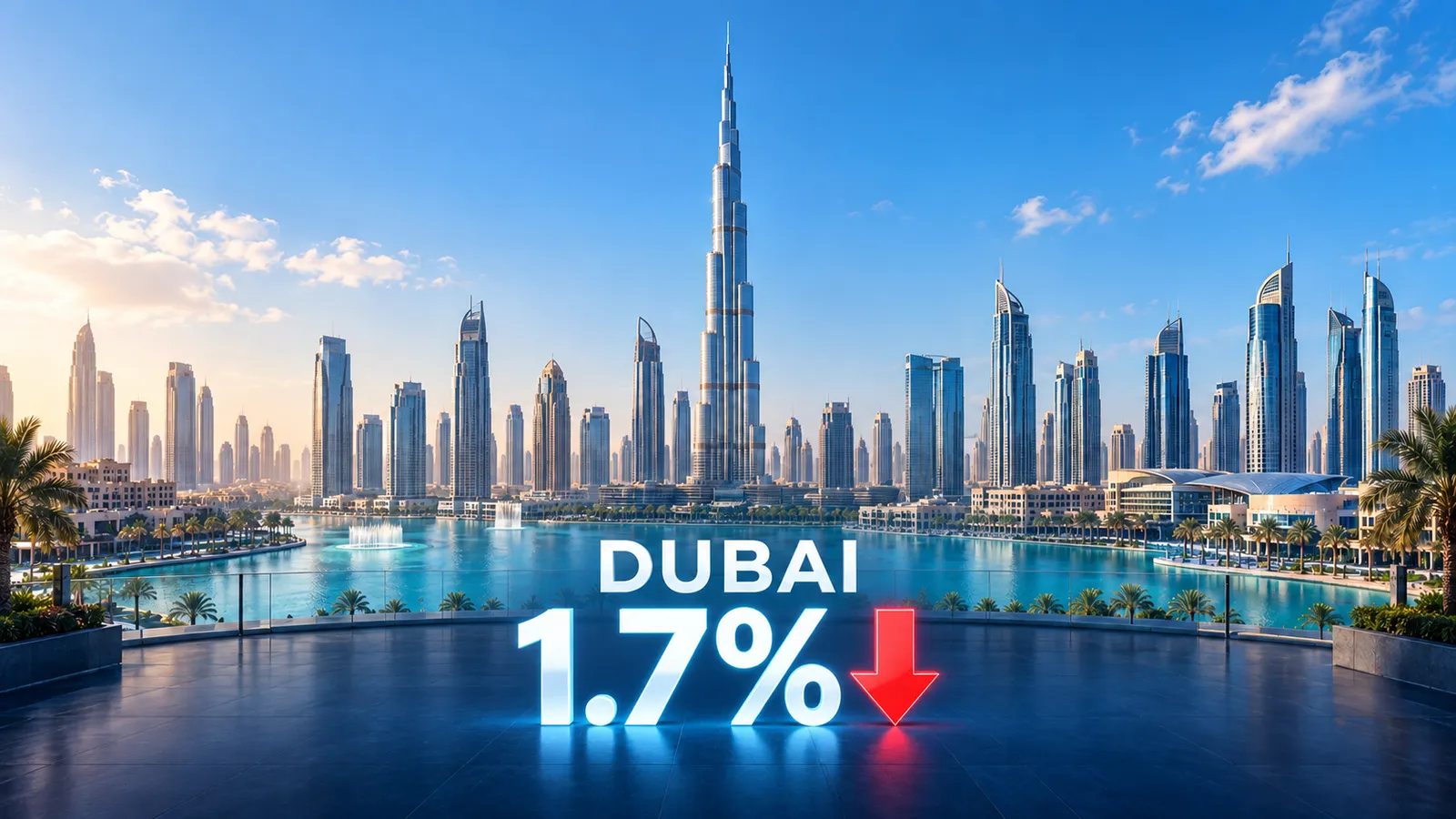
Dubai property prices fell 1.7 percent in the year to August 2026
Dubai's average residential sales price was AED 1,636 per square foot in August 2026, down 1.7 percent on the same month a year earlier. The figure comes from the consultancy Cavendish Maxwell and was reported on 7 September 2026.
It is the first annual decline in Dubai house prices since February 2021. Prices were also 1.3 percent lower over the latest three-month period, so this is a direction rather than a single soft month.
That sentence will read as bad news to anyone holding Dubai stock and as an opening to anyone who is not. Both readings are premature. What the number actually shows is a market changing gear, and the three series underneath it are moving apart.
Those three series are price, transaction volume and rent. For most of the last five years they moved together, which let a single headline stand in for the whole Dubai property market. In 2026 they separated, and a reader who tracks only one of them will draw the wrong conclusion from it.
The turn happened inside 2026, not before it
The useful comparison is with the start of the same year. In its first-quarter 2026 report, Cavendish Maxwell put the average price at AED 1,683 per square foot, up 9.6 percent year on year and up 0.6 percent on the previous quarter.
So between the first quarter and August the annual rate went from plus 9.6 percent to minus 1.7 percent. Subtracting one from the other gives a swing of more than eleven points, and it happened entirely within 2026.
The report itself flagged the slowdown before the fall arrived. It described that 9.6 percent as the slowest annual growth since the first quarter of 2023. The quarter-on-quarter figure of 0.6 percent was already close to flat. The annual number was still high because it was measuring against a fast 2025, not because the market was still accelerating.
This matters for how you read anything published in the middle of the year. A presentation dated September that quotes first-quarter prices is describing a market that no longer exists, and at least one developer deck circulating this month does exactly that.
Transaction value fell further than price did
Price is the headline, but activity moved more. The fall in transaction value is many times the size of the fall in the price series.
Cavendish Maxwell put transaction values in the first eight months of 2026 at nearly AED 270 billion, which is 24 percent lower than the same period of 2025. August alone recorded about 10,900 home sales, roughly 14 percent fewer than in July, worth AED 23.4 billion.
Set that against the first quarter, when the same consultancy recorded 44,200 transactions worth AED 139.1 billion, up 21.5 percent in value on the year before. Both the price series and the volume series peaked and turned during 2026, and the volume series moved first and further.
A 24 percent drop in eight-month transaction value against an August price only 1.7 percent lower points to fewer deals rather than much cheaper ones. No published figure gives the eight-month transaction count, so treat that as a reading of the two series rather than a measured one.
Off-plan is where most of the remaining activity sits. It made up about 75 percent of residential sales in August, and 73 percent of transactions in the first quarter. A market that is three quarters off-plan is a market whose reported price is heavily influenced by what developers choose to launch and at what price. That is another reason to read a single monthly figure carefully.
It also changes what a falling price index means. If launch pricing softens, the index falls even when nothing has changed in the resale market for completed stock. The reverse is true as well. Separating the two is the single most useful thing a buyer can do with this data, and it is not something the headline number does for you.
Rent is the series that did not turn
Here is the part that gets lost when the coverage is about prices.
Cavendish Maxwell put the average rent in Dubai in the first quarter of 2026 at AED 76.1 per square foot a year, up 10.2 percent on the year before. The same report gave gross rental yields of 7.2 percent for apartments and 5.0 percent for villas and townhouses.
Rents rise when people arrive, and Dubai's resident population grew by roughly 332,000 during 2025, according to the Dubai Data and Statistics Establishment. Sales prices respond to investor sentiment, credit and the news cycle. The two can point in opposite directions for a long time, and in 2026 they did.
One caution belongs with the rent series too. That 10.2 percent rise was described in the same report as the slowest annual rent growth since the fourth quarter of 2022. Rents are decelerating as well, just later than prices. Build an income case on today's rent level rather than on an assumption that today's rent growth continues.
For an income buyer that combination is unusual. A softer entry price with a firm rent raises the yield on the same asset. That is the arithmetic behind the argument that a cooling market suits a landlord better than it suits a trader.
One caution belongs with those yield figures. They are gross. In Dubai an annual service charge is payable per square foot. It varies substantially by building and unit type, and it comes out of the rent before anything reaches the owner. A 7.2 percent gross yield is not a 7.2 percent return, and the gap between the two is the number worth asking for. Our guide to buying in Dubai covers where that cost sits in the purchase.
Residency thresholds sit alongside this for anyone buying from abroad, and they are set independently of the price cycle. The Dubai Golden Visa page sets out the current levels.
What this changes for a buyer
Four things follow, and none of them is a prediction.
- Yield becomes easier to underwrite than capital growth. With prices flat to slightly down and rents rising, the income line is the part of the return you can actually model. Treat capital appreciation as the unknown, not the plan.
- The date on a figure now matters as much as the figure. A first-quarter price and an August price tell opposite stories about the same year. Ask which month any number refers to before you use it.
- Completed stock and off-plan have separated. Three quarters of sales are off-plan, which means the visible price is shaped by launch pricing. A completed, tenanted unit prices against what tenants actually pay, and our UAE buying guide sets out the costs that come with it.
- A 24 percent fall in transaction value is a negotiating condition. Fewer buyers in the market changes what a seller will accept, particularly on stock that has been listed for a while.
The indicator to watch is the next monthly reading of the same series. One annual decline of 1.7 percent after five and a half years without one is a turn; whether it becomes a trend depends on whether the next two or three months extend it. Rent and yield are the second series worth tracking, because they are what the income case rests on.
Before you commit in Dubai
If you are reading Dubai property prices as an entry signal, decide first whether you are buying income or buying appreciation, because the current data supports one of those far better than the other. Check the month behind every figure you are shown, and ask for the service charge before you accept a quoted yield. SmartDecision Properties works through that with buyers, from separating completed stock from off-plan to setting out the full cost of ownership.
Common questions
- Are Dubai property prices going down in 2026?
- They fell 1.7 percent in the year to August 2026, the first annual decline since February 2021, on Cavendish Maxwell figures. Prices were also 1.3 percent lower across the latest three months. One annual decline after five and a half years without one is a turn in direction, and whether it continues is not something any published figure can tell you yet.
- Is now a good time to buy property in Dubai?
- It depends on what you are buying for. Rents and yields held up while prices softened, which favours a buyer looking for income. A buyer relying on quick capital appreciation is making a call the current data does not support. Decide which of the two you are before you look at listings.
- What is the average Dubai rental yield right now?
- In the first quarter of 2026 gross rental yields were 7.2 percent for apartments and 5.0 percent for villas and townhouses, according to Cavendish Maxwell. Those are gross figures. Subtract the annual service charge and any management fee to get the number that reaches you.
- Why is the Dubai property market slowing?
- The published data shows the slowdown rather than explains it. Transaction values in the first eight months of 2026 were 24 percent below the same period in 2025, and the annual price rate fell from 9.6 percent in the first quarter to minus 1.7 percent by August. Any single cause offered for that is an opinion, not a figure.
- Is Dubai off plan still worth buying in a falling market?
- Off-plan made up about 75 percent of Dubai sales in August 2026, so it is where most of the inventory is. The risk in a softening market is that you commit today at a price that is set by the developer and take delivery in a different market. A completed unit removes that timing risk and starts earning rent immediately.